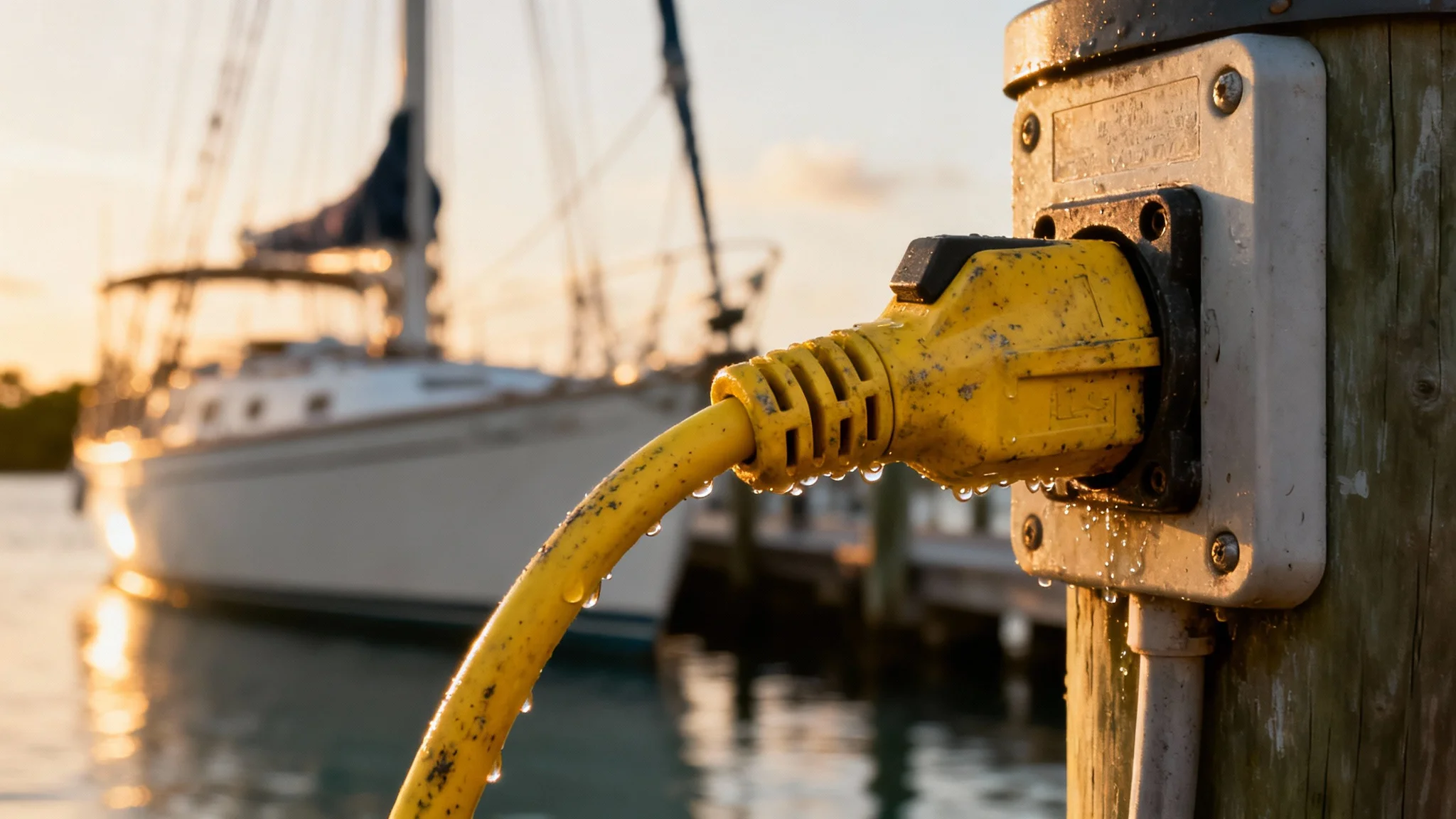
You plug in your shore power cord at the marina, flip the main breaker, and it immediately trips. Or maybe it holds for a few seconds before popping. You try again with the same result.
This is one of the most frustrating electrical problems boat owners face because the cause isn't obvious and the symptoms can vary. After years of troubleshooting shore power issues on boats throughout the Florida Keys, I've narrowed down the most common culprits.
Understanding Your Shore Power System
Before diving into troubleshooting, it helps to understand how your boat's AC electrical system works.
When you connect to shore power, electricity flows from the marina pedestal through your shore power cord, into your boat's AC panel, and then to individual circuits for air conditioning, water heater, battery charger, and outlets.
Your boat has two types of protective devices:
Main breaker: Protects against overcurrent (drawing too many amps) and is usually rated at 30A or 50A depending on your shore power inlet.
GFCI/ELCI protection: Protects against ground faults (current leaking to ground) and equipment leakage current. This is a safety device that prevents electrocution.
When the breaker trips immediately upon connecting, you're dealing with one of three problems: overcurrent, ground fault, or a short circuit. Each has different characteristics.
Immediate Trip: Short Circuit
If the breaker trips the instant you flip it on, you likely have a short circuit somewhere in the system. A short circuit is a direct connection between the hot wire and neutral (or ground), which causes a massive current spike.
Common Causes
Water intrusion in outlets or connections. Florida Keys boats live in a humid, salty environment. Water finds its way into shore power inlets, outlets, and junction boxes. When saltwater bridges the gap between hot and neutral terminals, you get a short.
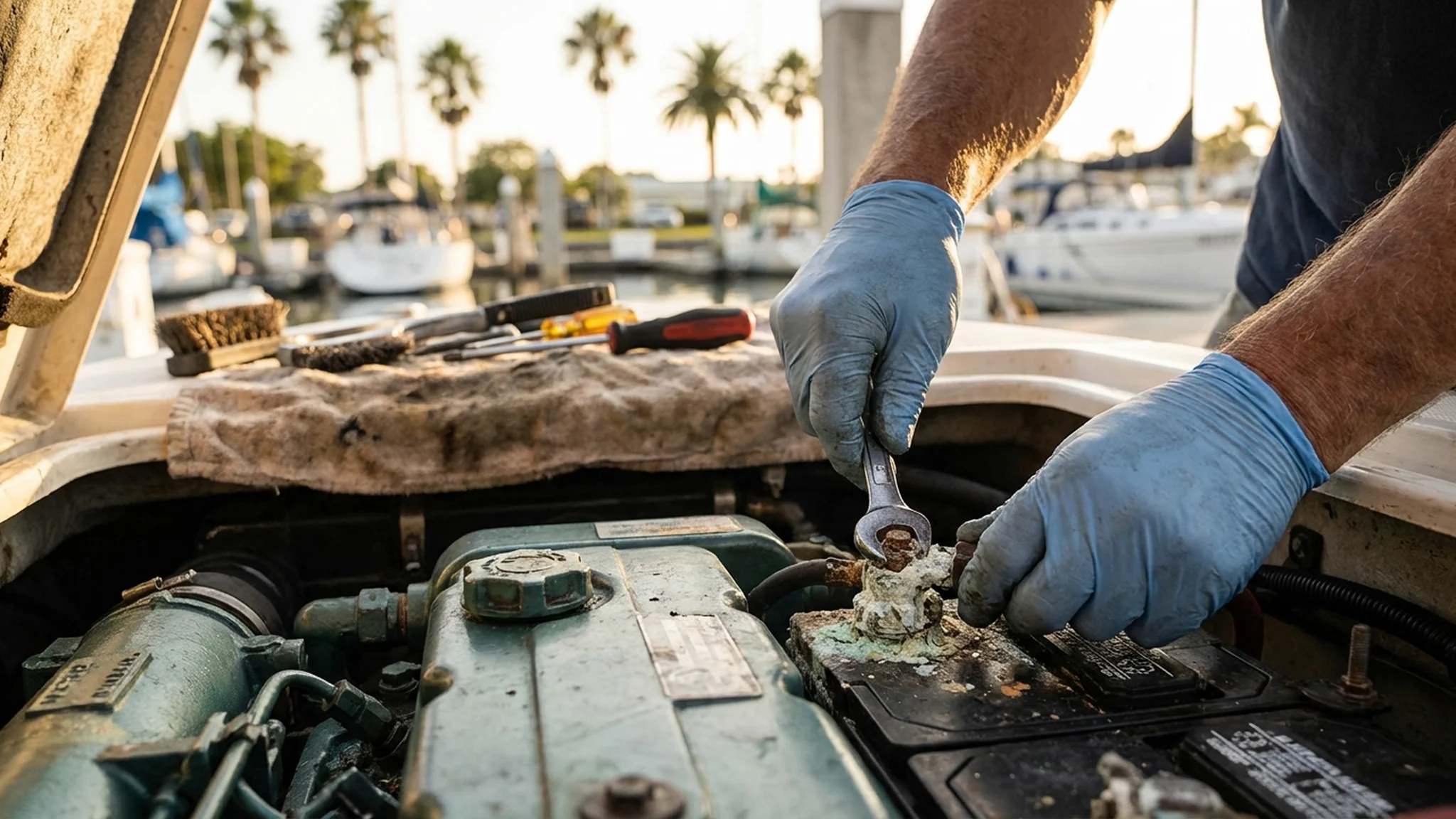
Check your shore power inlet first. Remove the cover and inspect for corrosion, moisture, or discoloration. Look at each AC outlet throughout the boat. Behind-the-panel connections are notorious for collecting condensation.
Damaged shore power cord. The cord itself takes abuse from constant connecting and disconnecting, UV exposure, and occasional drops into the water. Internal wire damage isn't always visible from outside.
Inspect the cord carefully at both ends where it enters the plug housings. Look for cuts, burns, or melted areas. If the cord is more than 5 years old and has been used regularly, replacement is often the best option.
Failed equipment. Air conditioners, water heaters, and battery chargers can fail in a way that creates an internal short. If the breaker trips even with all individual circuit breakers off, the problem is in the main wiring or shore power inlet. If it only trips when a specific breaker is on, you've identified the problem circuit.
Delayed Trip: Overcurrent
If the breaker holds for several seconds or minutes before tripping, you're probably overloading the circuit. This is especially common on 30-amp boats with air conditioning.
Common Causes
Running too many high-draw appliances simultaneously. A marine air conditioner alone can draw 12-15 amps at startup (and 8-10 amps running). Add a water heater (10-12 amps), battery charger (5-10 amps), and a few small appliances, and you've exceeded your 30-amp capacity.
Calculate your loads. Add up the amp draw of everything running. If the total exceeds your shore power rating, you need to stagger your usage or upgrade to 50-amp service.
Air conditioner issues. A struggling compressor draws more current than normal. Low refrigerant, dirty condenser coils, or a failing compressor motor all increase amp draw. If your A/C runs but trips the breaker after 10-15 minutes, the compressor might be overheating and drawing excessive current.
Startup surge. Electric motors draw 3-5 times their running current at startup. If your breaker trips right when the A/C compressor kicks on, the startup surge is exceeding the breaker's instantaneous trip threshold. This sometimes indicates a failing compressor capacitor.
GFCI/ELCI Trip: Ground Fault
Modern boats have Equipment Leakage Current Interrupter (ELCI) protection at the main shore power inlet. This device trips when it detects current flowing to ground rather than returning through the neutral wire. It's designed to prevent electrocution, both for people on the boat and swimmers in the water near the boat.
ELCI trips feel different from overcurrent trips. The breaker often trips immediately and firmly, and you'll usually see an indicator button popped out on the ELCI device.
Common Causes
Corroded or water-damaged equipment. When insulation breaks down in AC equipment, current can leak to the equipment's metal housing and from there to the boat's ground system. This is the exact situation ELCI is designed to detect.
Marine air conditioners are frequent offenders because their pump units sit in or near bilge water. Water heaters develop element corrosion. Battery chargers in damp engine rooms corrode internally.
Improper wiring. If a previous repair connected neutral and ground together incorrectly, the ELCI will detect this as a ground fault. This is actually dangerous wiring, and the ELCI is doing its job by tripping.
Cumulative leakage. Every piece of AC equipment has some small amount of leakage current. Individually, these are below the trip threshold. But when you have multiple older appliances, the cumulative leakage can exceed the 30mA trip point of the ELCI.
Test this by turning off all circuit breakers and then turning them on one at a time. If the ELCI holds with each individual circuit but trips when you have several on, cumulative leakage is your problem.
Dockside wiring issues. Sometimes the problem isn't your boat at all. Faulty marina pedestals, damaged dock wiring, or ground faults in neighboring boats can cause your ELCI to trip. If your boat worked fine at a different marina, the dock wiring should be investigated.
Troubleshooting Steps
Step 1: Isolate the Problem
Turn off all individual AC circuit breakers on your boat's panel. Disconnect everything plugged into outlets. Then try connecting to shore power with only the main breaker on.
If it still trips: The problem is in your main wiring, shore power inlet, or shore power cord.
If it holds: Turn on circuit breakers one at a time to identify which circuit is causing the problem.
Step 2: Check the Cord and Inlet
Inspect your shore power cord and inlet visually. Look for:
Discoloration or melting at plug terminals
Corrosion (green on copper, white on aluminum)
Burn marks
Moisture inside connections
Test the cord by borrowing a known-good cord from a neighbor. If the borrowed cord works, replace yours.
Step 3: Test Individual Circuits
Once you've identified the problem circuit, unplug or disconnect individual devices on that circuit. A process of elimination usually reveals the faulty equipment.
Step 4: Look for Water
Water and electricity create problems. Check:
Inside the shore power inlet housing
Behind outlets, especially in the head and galley
Around the base of water heaters
At A/C pump connections in the bilge
Any junction boxes or wire connections
Even small amounts of moisture cause intermittent trips in humid conditions.
When to Call a Professional
Shore power troubleshooting involves working with 120V (or 240V on 50-amp systems) electricity. If you're not comfortable with electrical testing or don't have a quality multimeter, this is a good time to call in a marine electrician.
You should definitely get professional help if:
You smell burning or see discoloration on wiring
The problem is intermittent and you can't isolate it
Your ELCI trips consistently but individual circuits test fine
The problem started after recent electrical work
Ignoring shore power problems puts both your boat and anyone swimming near it at risk. Ground faults can create dangerous voltage in the water around your boat without any visible sign. This is called Electric Shock Drowning (ESD), and it's a serious hazard in marinas.
A complete AC safety inspection checks for proper grounding, ELCI function, polarity, and current leakage. If your boat is more than 10 years old and has never had one, it's worth the peace of mind.